
Many folks seem to confuse a horse’s innate ability to canter with a balanced, soft canter.
These are not the same thing. Many who bring a horse to me for training tell me their horse canters just fine. I have them ‘show’ me on line and I just shake my head and say, “That sucks! That’s not a canter, that’s a mess.” The horse is bolting off, half sideways, either counter-cantering or cross-cantering and braced every which way to Timbuktu with the head to the outside and the ribs bowed in to the center of the circle.
“If you don’t know enough to fix problems in a horse that already exist, then you don’t know enough to ensure you don’t put problems in a horse.” – Ross Jacobs.
I put this quote here because of course it’s true. Many just kick their horse to go and have no idea what the legs are doing. However, I can’t get into that here because learning what a proper canter is takes help. I’m going to discuss one way to help a horse if you already know how a canter should go. But, because the horse learns so much under this circumstance, there’s a good chance that even if you don’t know what your leads are, you may learn them as the horse is set up for success in this manner.
There are a lot of horses out there falling in on the corners with their heads to the outside and slanted like a motorcycle around a turn. Because this is scary or at least uncomfortable for a rider, the rider tries to hold the horse up or pull the horse into a more balanced turn. The horse then lets them struggle with that.
It’s a serious mistake trying to “help” a horse balance by carrying him as you will have to continue to carry him, since you haven’t taught him how to carry himself. Just like a kid who doesn’t want to walk and lets or causes by behavior, his parents to tote him around. Now, teaching a horse to bend softly while cantering is imperative to balanced, self-carriage. However, it can be difficult and scary for those not familiar with this to allow the horse to learn while mounted. Timing
and feel as well as balance and the skills needed take some learning by the person. That’s why getting it online is a good idea.
While I can’t teach everything involved in a few paragraphs, (maybe I’ll write a future book on that, but the list is long) if you already know your leads it will be a great exercise to help your horse learn to carry himself appropriately balanced and also help him learn to keep a thinking head and not rush.
I’m giving you the nutshell version and you can email me or some such if you want more.
1) You need some mud. Yep, sloppy or whatever, but it has to be slippery footing, at least on some part of the footing. It doesn’t have to be mud the whole way around. Having a slippery spot on a quarter of the circle is fine. Don’t be a puss, horses learn to work in the mud under many different circumstances. The horses that are “protected” by over-protective owners of course will never learn and be stumble bums. Horses are horses-not what people decide is right for the people.
2) You MUST maintain your feet in the same place. You will be turning – keeping your bellybutton in front of the nostrils, but you are NOT going to drift with the horse when his weight pulls on the line. Get yourself a red X to mark your spot and stay on it.
3) You can start with a 20 foot rope or so and as you get better with your skills and your horse’s learning, you’ll be shortening it up by about half. Need I mention that you don’t get to use ANY gear other than the halter, line, and a stick and string or lunge whip or such. Extra apparatus such as side reins or draw reins are a no-no. The horse needs the opportunity to learn, not be held up by mechanical means.
Now then, you’re going to start your horse at the trot. Precious will be slip-sliding away and you will allow that. Just maintain your spot and your rope length and encourage Precious to find her way. When she’s learning how to navigate the slippery spots you’ll see how quickly she picks up what is necessary for her. Then after she gets a bit more comfortable, ask for a couple of canter strides. Let her find her way and break into a trot to re-balance and then when she’s of sound mind, ask for a couple more canter strides. Depending on how it’s going you can stop there and then pick it back up the next session and ask for more consistency and more strides.
So, you should be good to go for your beginning mud work. Let me know how it goes and I’ll be doing another article on progressing from here.
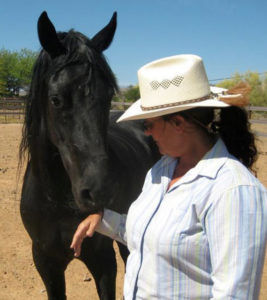 She was ten years old and had been kept in a pen for so long her legs hardly held up and sometimes didn’t while she scrambled to bolt away. A jet black Morgan, stunningly beautiful with black eyes, flowing mane and tail and crooked hind legs and strangely shaped hind hooves. Talk about spooky – I ducked between the rails of the pen she was in and she tried to jump out the back side. The guy who ‘trained’ her, well, he thinks standing in a round pen while she frantically runs so out of control that she’s at a 45 degree angle with the footing flinging hither and thither 30 feet out. She was in a total lather and had to be blocked to stop. Her eyes were white with terror. He, meanwhile, stood there in the ‘position’ with his arm cocked leaning on his stick while she lost her mind. Then, he saddled her up and got on and kinda rode her. Meaning he stayed on at a very tense walk and trot with reins only a few inces long and couldn’t get her any where near the rail or canter. A year later, after standing in that same pen the whole time, I brought her home amd turned her out with my herd. BTW she couldn’t be caught. What a lover puss. While she will come, she still has a thought that if you have a rope it may not go well for her. I’ve only been on her a handful of times and that bareback with a halter, but she’s doing very well. Updates as I get around to them.
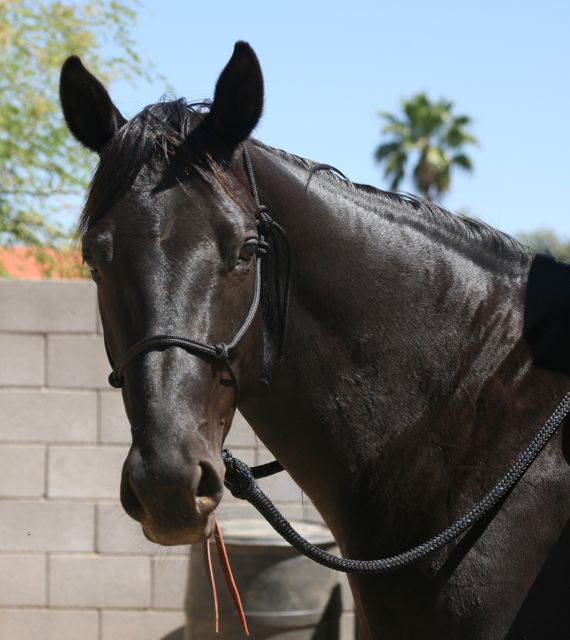 I was her last stop before the Alpo can. This girl is the most dangerous horse I’ve ever been around in my life. What did “they” do to her to make her so dangerous? And by dangerous, I mean: She allowed no one near her. Within range for her was anywhere she could reach or get to. She’d charge you, even lunging over the fence. Just hope you get through it and far enough away to live. She struck, bit and kicked, launched whatever cowboy got on her and then, like a bull, turned and attacked. Broke bones in several trainers bodies before coming to me at the ripe old age of three. The trainers who owned her could not get within thirty feet of a fence without her trying to attack them. They purchased her as a one-year-old at the World sale in OK and when the breeder went into the stall, she sent him flying over the stall wall and broke some parts. The trainer/owner had gotten on her, but she launched him and then like a bull, turned and attacked breaking his collar bone. She had to be removed from the stable where they trained because no one could even clean the stall. They sent her to a trainer whose business card USED to read “Problem horses a specialty.” She launched him and attacked again with the same result. he told them to come get her, she was hopeless. They turned her out in a 100 acre pasture for six months hoping she’d settle down, but the other people who had horses in the pasture couldn’t get their horses because she’d attack them. She was temporarily contained in a round pen of a mutual acquintance while they tried to figure out what to do with her. They had the vet out to draw blood to check for hormone problems. If anyone even placed a hand on her, she’d squeal and kick and squirt pee. While in the stock for the vet to draw the blood, she managed to kick him and break his arm. Blood tests were negative. The mutual acquintance said if they wanted to give her one more shot before they took her to the killers, she needed to go to Lauren’s. (I keep a low profile. They didn’t know me.) They said drug her, throw her in the trailer and get her over there. I was gone to lessons the morning she was to be delivered, so I left instructions to leave her in the round pen. Now I was not given any info on this horse, just that they wanted her to “go long and low at a lope.” I had a message on my cell that said, “Hope your pen is still up when you get home.” Hmmmmm….. I walked out to see the new arrival. As I approached the fence, this beautiful horse ambled toward me and started to put her head forward. I noticed that she had a rear hoof that was completely broken up to the hair line at the quarter line. Lots of fresh blood. Don’t know what happened getting her here. I reached up a hand to pet her face and suddenly, both hind hooves were over the 5 foot rail right at my head. “Oh sweetheart,” I said, “that’s not the way we do things here.” She then pinned her ears and lunged over the rail at me with her teeth and eyes snapping. Yikes! I got my stick and string so I could work with her in the pen and hopefully live. She didn’t have a halter on and I was pretty sure I didn’t want to be close enough to put one on her anyway. I had to do some pretty good swinging to even get in the pen and keep her off me. She didn’t care. I felt bad about the broken hoof, but it was obvious that that would be a long time healing and there wasn’t anything I could do about it. She didn’t seem to care either. High, shut-down pain threshold. I sent her off while she tried to attack and then bolted off squealing and squirting pee about 4-5 feet straight out behind her. I tested several options for her to come in or quiet down, the answer was a resounding “NO”. I was running around with her so I could touch her with the string and also use it when she attacked to start our conversation. Getting her to go away was important as a precursor to her giving to pressure and not killing me. She had no inclination to do so and there were many times that I knew my life was seriously in danger. To make a long story short, two hours later, both of us were covered in sweat and pee. She was changing direction and sometimes coming in half way to me. Then, suddenly she just stopped, turned in to me and walked up to me with her head down at her knees. She stood there heaving and dripping with her tail hangling limp between her legs and pee just started pouring out of her. I petted her forehead and said, “Sweetheart, where in the world did you even have that after two hours of squirting it all over?” Whatever happened to this horse before, she decided that she was going to get the human before the human could get her. I found out later that in addition to the multitud of broken bones she left in her wake, the owner had tied her legs and thrown her and left her laying in the sun under a tarp for several hours. She also had several serious wounds that they had stitched up on her lower legs without the help of a vet. Those scars will remain, the mind scars have mostly healed. I absolutely adore this horse and she’s like a barnacle. Follows me everywhere and always is a huge help teaching other horses how to do tricks and work with sidepassing over barrels or walking in the tire bundle or tarp work. She’s always right there on her own (frequently in the way) to show the newbie how to do it.
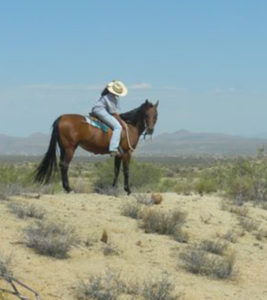 Would you take that one with you, too?” the owner asked me. I made a face. I was there to see about a throw away (by them) horse for my daughter (Gryffindor is on the cover of my book with her). “No.” I said. “That’s like a large Great Dane. I don’t have any use for a tiny Arab pony.” But, the little bay horse whispered, “I’ll be your best horse ever.” Believe me, I throw that up in her face every once in a while when she gets a hair up her butt and she’s not being my best horse ever. She weighs about 200 pounds more than she did then. And with only about 225 rides in her, she’s a phenomenal horse. She’s perfectly behaved galloping in the mountains bridle-less with just a string around her neck that I don’t have to use. She’s so smooth in her gaits. She jumps like a bird; completely quiet and composed and we’ve started working on piaffe. I can put someone who’s never been on a horse before on her with a halter and take them for a ride in the desert or mountains. She’s also the one I’m on laying backward reading a book and in the un-spooky horse blog post. As to the reading picture, she had never been in the backyard, I had never laid backward on her. She didn’t even have so much as a string around her neck for that photo shoot. Very smart, but that’s an Arab for ya. Tell her what you want and be clear about it and she’ll give it her best try. I’ll keep adding blog posts featuring her and stories of old as we go.
Recent Comments